codification treadmill
The Codification Treadmill
The person who replaces you probably won't be AI. It'll be someone from the next department over who learned to use it.
I had coffee recently with someone who runs a recruitment platform and we got onto where strategy roles are going. His take was that demand for pure strategy hires -- the classic "I make the deck, someone else builds the thing" profile -- has fallen off. Not because companies stopped needing strategic thinking but because companies are replacing pure strategists with specialists on tap. A pricing expert comes in, solves the pricing problem, and leaves. A supply chain person restructures the network and moves on etc etc. The pure strategist who agonises over whether the right word on the slide is "extension" or "enhancement" is being swapped out for someone who shows up, fixes a thing, and has a real impact.
Strategy is becoming more fluid and task based, not a permanent seat at the table.
But there's a second shift happening alongside that one, and I know it because I'm living it day to day.
Product people are doing strategy. Strategy people are doing product. The engineers I know are making product calls. The product people are prototyping strategic hypotheses.
Three disciplines slowly bleeding into the other. Not that that's a bad thing...
I'm a strategy person by background. Two years ago I'd write a recommendation and hand it to a product team. Now.. I describe what I want to Claude, iterate on the code, and ship it.
This is like waking up to find that all the fences and roads in your neighbourhood were removed. You're just... weirdly together.
How it's already happening
LinkedIn scrapped its Associate Product Manager programme in late 2025 and replaced it with "Associate Product Builder". Not "product manager who uses AI" but "BUILDER". The new track expects hires to code, design, and do product management simultaneously. Microsoft, Airbnb, and Snap have made similar moves. These aren't branding exercises -- these are org chart changes at companies with tens of thousands of employees.
You might have heard of a dude called Leonardo da Vinci. Painter, engineer, anatomist, architect, inventor. Yes he was a freak of nature genius, but in the 1400s that's just what a brilliant person did. The boundaries between those fields barely existed. Then industrialisation broke that model apart. The factory made it economically irrational for one person to do everything, because no single craftsman could match the throughput of a production line. So we split da Vinci into departments. The designer didn't touch the factory floor. The engineer never met the customer. The salesperson never sketched a prototype.
AI is running that in reverse. The scarce resource in software isn't engineering capacity anymore -- it's knowing what's actually worth building. When building is cheap, the person who knows WHY and HOW to build something becomes more valuable than the person who CAN code it (at least for simpler implementation). When one person with the right tools can match the output of a small cross functional team, the economic incentive flips back to recombining the roles to maximise what a brilliant person can do. We're not becoming generalists. We're encouraged to use our multifaceted skillsets again -- except instead of da Vinci's workshop, we have a Macbook or Thinkpad and our workshop intern/apprentice is an LLM.
So we have three armies mobilised at once:
1. Strategy is invading product; when you can prototype a hypothesis in an afternoon instead of writing a 40 slide deck, why would you hand it off? You just test it yourself. The gap between "I have a strategic recommendation" and "I shipped a working prototype" used to be two departments and a quarter of roadmap negotiations. Now it's roughly the width of a well written prompt.
2. Product is invading engineering; product people are describing what they want to AI and shipping code directly. Two years ago that meant a bunch of Miro/Figma flows. Now it means actual, deployed features/prototypes. The gap between "I know what to build" and "I can build it" used to be years of education on code reusability, big-O notation, and normalised databases. That gap is closing fast.
3. Engineering is invading product; when AI handles the implementation grind, shipping the wrong feature quickly becomes worse than shipping the right feature slowly. So engineers are picking up customer context, market positioning, user psychology -- not because they suddenly love user research, but because the alternative is building things nobody asked for at twice the speed. They're also having to get better at architecture decisions.
Each discipline thinks it's just "expanding its skill set." From every other discipline's perspective, someone's coming for their job whether they realise it or not.
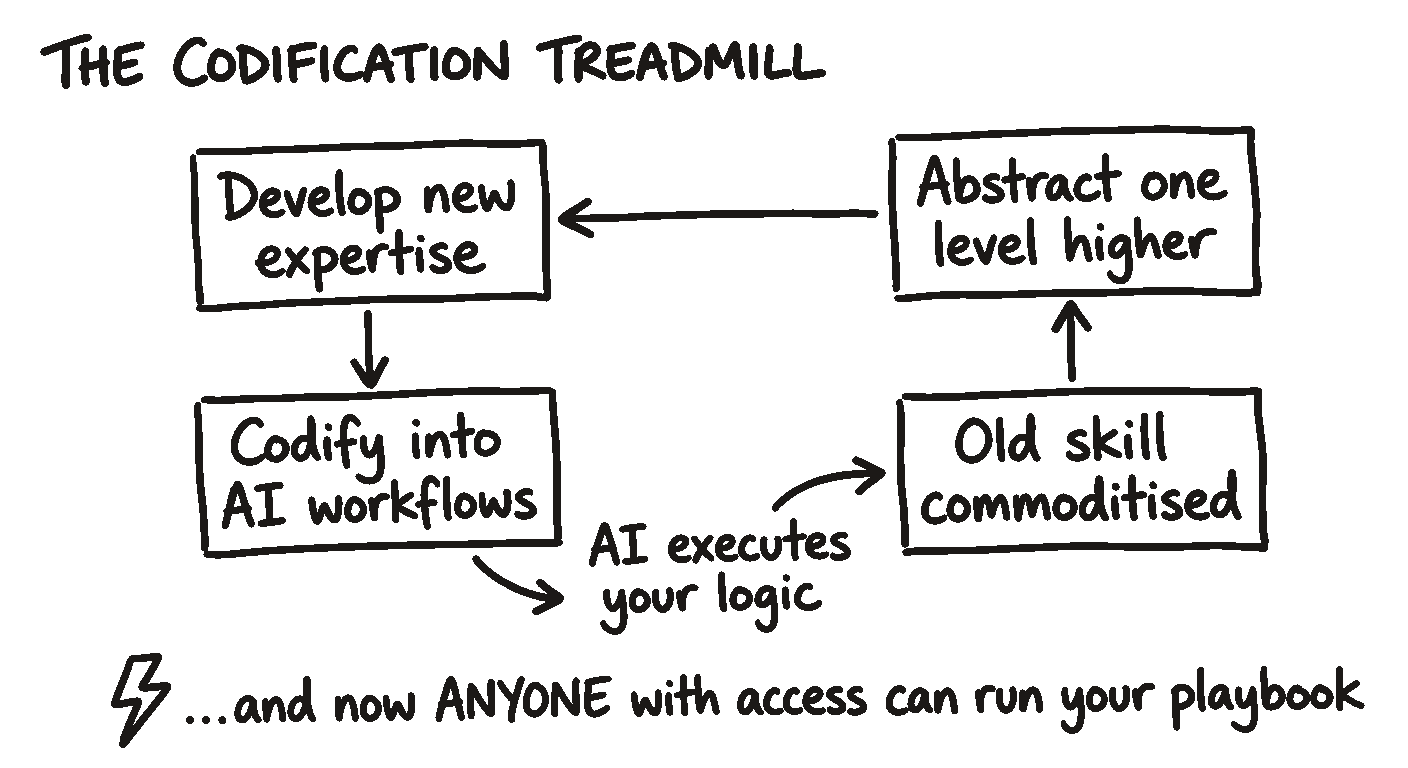
Right now, each specialist's most valuable move is codifying their reasoning into AI workflows. The strategy person writes prompt templates that encode their market analysis logic. The product person encodes customer focussed design/UX principles that guide AI development. The engineer creates system architectures and review criteria that AI follows.
But codification is a one way transfer.
It's like writing a recipe. While it's in your head, only you can cook the dish. The moment you write it down, anyone can. Researchers call this "The Paradox of Professional Input" -- the same act that makes you indispensable today makes you replaceable tomorrow.
And you don't just hand it to AI. You hand it to ANYONE with access to that AI. The strategy person's market analysis framework? A product person can now run it. The engineer's architecture review criteria? A product person can apply it.
You spent years developing a skill, distilled it into a workflow, and now it's a tool in your competitor's belt. Except your competitor sits three desks away and makes annoying slurping sounds when drinking their coffee.
You codify your current expertise. AI absorbs it. Your old skill becomes commodity. You climb one level of abstraction higher. Develop new expertise. Codify that. AI absorbs it again. The moment you are unable to keep climbing, you are forced off the treadmill -- and the next best person is already running on it.
That fluid labour trend from the coffee conversation? This is where it connects. When strategy expertise gets codified, you don't need a generalist sitting with a MECE hypothesis tree running the same playbook for six months. You need a specialist who arrives with deep, not yet codified knowledge, applies it to a specific problem, and moves on before the treadmill catches up. The shift from permanent generalists to fluid specialists isn't random -- it will be the market's response to codification.
So who wins?
71% of executives say they'd prefer a less experienced candidate with AI skills over a more experienced one without. They're betting the answer is adaptability over tenure.
The real danger isn't AI replacing you. It's losing your job to a colleague who used AI to learn your discipline while you were busy addressing the markup/comments/code review of your work.
But there's a trap in the race. When AI handles the junior work, the apprenticeship pipeline that produces seniors breaks. A study of 758 BCG consultants found that those using GPT-4 performed better within the AI's capability range, but WORSE outside it -- and junior staff particularly struggled to recognise where that boundary was.
It's the difference between a chef who learned to cook and then got a Thermomix, versus someone who's only ever used a Thermomix. The first person knows what to do when the machine breaks. The second just has an expensive paperweight.
I do this for the love of writing — each subscriber costs me money. But please subscribe anyway and spread the word.
The early adopters racing to absorb adjacent disciplines. But if the absorption is shallow -- prompting without understanding -- you end up mediocre at three things instead of excellent at one.
I wrote earlier this year about the liquid labour matrix -- organisations running a rigid core of experienced staff alongside a fluid network of AI and specialists. This post is about what's happening on both sides of that matrix at once. The fluid network is expanding -- specialists brought in to solve a specific problem and move on, exactly what that coffee conversation described. And inside the rigid core, the roles aren't merging collaboratively. They're merging competitively. Each discipline is trying to absorb the others before being absorbed itself.
The companies that maintain rigid role boundaries will ship slower. The ones that collapse roles without preserving depth will ship the wrong things faster -- which is worse.
I think the treadmill does have a top. It's wherever legal liability and personal accountability become too high to delegate -- the level where someone has to sign their name, stake their reputation, and answer for the outcome. You can codify analysis, automate execution, and hand strategy playbooks to anyone with a login. But the moment a decision carries real consequences -- regulatory exposure, fiduciary duty, career ending risk -- the person making it needs to actually understand what they're deciding, not just trust the workflow.
That's probably the ceiling. Everything below it is codifiable. And the people who refuse to step on the treadmill are already falling behind.
Disclaimer: Thoughts are my own and do not represent any other parties.
Newsletter
I do this for the love of writing.
Each subscriber costs me money, but please do it anyway and spread the word. Monthly at most.
You might also like
The Six Simple Machines of AI
Every AI product in a business is a few of six simple machines bolted together. An assembly inherits every failure of every machine inside it.
AI shopping is years away. The infrastructure isn't.
When the AI does the buying, value migrates from attention to delegation. Stripe's five level map shows where commerce is today and what changes at Level 4.
Who owns the network?
The real competitive advantage in agentic AI won't go to those controlling customer interfaces -- it will go to whoever controls the supply networks AI agents depend on.