liquid labour matrix
Liquid labour
Originally published on LinkedIn
The future of work won't be about choosing between AI and humans; it's about doing both at the same time. While people talk about mass unemployment and downsizing teams, the top orgs will be those who keep a strong, experienced core to manage a flexible, AI supported workforce.
The myth of labour substitution
Most people assume every AI agent replaces a human. This misses the bigger picture. In most developed countries, we actually have a labour shortage. AI is a tool to keep the economy moving as the population ages. Furthermore, while AI might save resources, this rarely translates to pure job losses (only 4% of orgs downsized in this UK study).
Orgs usually reinvest the saved time into higher value work. The graph below shows that demand for AI related skills has increased in Australia recently, suggesting some early evidence for the 'reinstatement' effect, as new roles that require AI related skills are becoming more common.
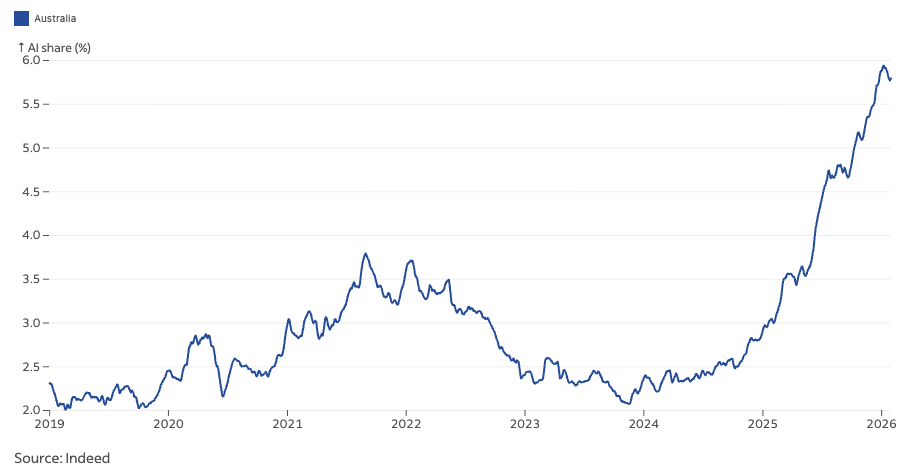
Share (%) of job postings on Indeed containing AI terms in Australia. Updated til January 2026. Source: Indeed
The danger isn't that humans become useless, it's that companies are too rigid to let them move on to more important things.
RIP Middle Management
Where is the real change happening? It's in the middle. Historically, companies hired layers of managers just to move information around and check boxes. AI agents are now hollowing out this "coordination" layer. By turning routine management into a background process, AI is forcing companies to flatten their structures.
Humans vs. org structure -- as it relates to AI
Most leaders treat AI like a faster typewriter. That's a mistake. To actually gain an edge, you have to move people from doing chores to overseeing systems.
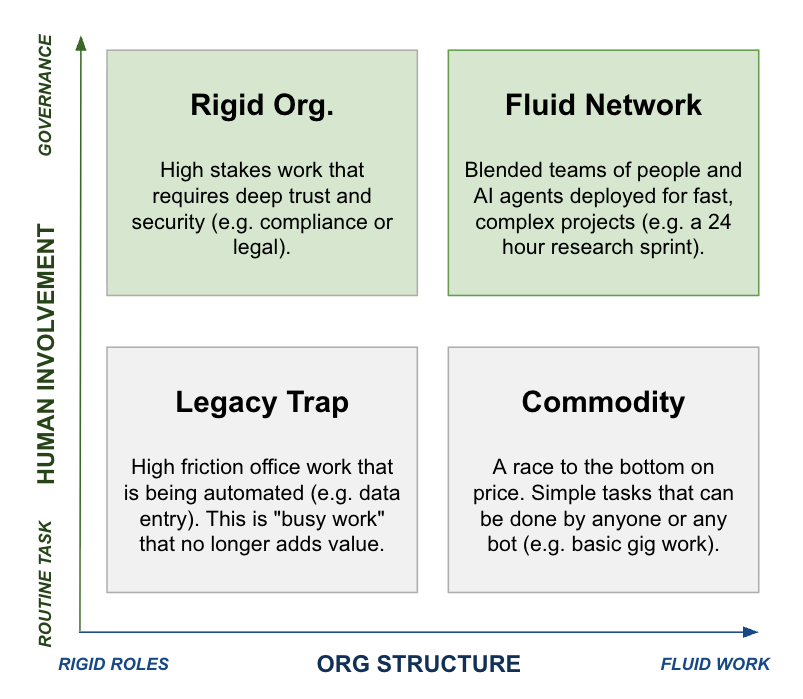
The liquid labour matrix -- was a whiteboard sketch at one point.
We can map this shift across my hastily drawn 2x2 that I call the liquid labour matrix, defined by two dimensions: how we use humans in orgs, and how flexibly we structure organisations (rigid roles vs. fluid work). The bottom two quadrants are due to be automated rapidly if not already. The debate lies in the top two quadrants.
The hybrid path I foresee is the Rigid Org. + Fluid Network -- the most successful companies won't just pick one quadrant. They will run two layers at once. I envision this as two main components:
- A core of experienced veterans (rigid): This is the heart of the company -- long-term employees who understand the unwritten rules, the brand, and the clients. They have the "gut feeling" and conceptual depth to make big decisions that an AI can't. A leader uses AI to scan years of company data; the AI does the work, but the human makes the decision. They act as the final gatekeeper because they have the institutional memory that a temporary contractor or an AI simply lacks.
- A flexible swarm of human and AI agents (fluid): This is the outer layer -- teams of AI and specialists that come together for a specific project and then disband. Using a tool like CrewAI, a lead can launch a "swarm" of AI agents to build a prototype or solve a complex issue in a fraction of the time. They scale up when they need speed and scale down when the job is done.
I do this for the love of writing — each subscriber costs me money. But please subscribe anyway and spread the word.
Why I think this is likely...
- Accountability: shareholders need a person to be responsible for the big risks. A "fluid network" of agentic bots or AI can't be held liable in court; a senior leader can.
- Knowledge: temporary teams don't know your company's "secret sauce." You need a permanent core to keep that knowledge alive.
- Security: you can't let sensitive data leak into the "liquid" market. You keep your most valuable data in the core and use the flexible periphery for modular and lower-risk execution.
The question for your org is about which parts of your business you can afford to relax control on and which parts you must protect. If you go too fluid, you lose your identity. If you stay too rigid, you get left behind. The highest performing orgs will be the ones that can maximise speed and flexible execution without losing their core values.
Prompt
Disclaimer: Thoughts are my own and do not represent any other parties.
Newsletter
I do this for the love of writing.
Each subscriber costs me money, but please do it anyway and spread the word. Monthly at most.
You might also like
The Six Simple Machines of AI
Every AI product in a business is a few of six simple machines bolted together. An assembly inherits every failure of every machine inside it.
AI shopping is years away. The infrastructure isn't.
When the AI does the buying, value migrates from attention to delegation. Stripe's five level map shows where commerce is today and what changes at Level 4.
The Codification Treadmill
The person who replaces you probably won't be AI. It'll be someone from the next department over who learned to use it.