discard rate
What the World Cup tells us about talent
Nobody can spot a future professional at 12. The systems that win are the ones that throw away the fewest kids.
tl;dr
- Nobody can pick winners early. Below age 15, being the best kid on the pitch predicts almost nothing.
- Everyone picks early anyway because selecting is cheap and visible.
- The systems that waste the least talent discard fewer kids: cheap entry, proper coaches from day one, late cuts. Big countries can afford to be inefficient and waste talent. Small countries cannot. Keep the funnel as big as you can.
- Same rules work for us in day to day life. Sample your interests widely, make practice cheap, get coached early, and don't cut yourself at week 3.
Like most casual sports fans, I only watch football (soccer, to be clear) during World Cups. The highlight for me was Cabo Verde... an island nation of about 525,000 people, the smallest ever to reach the knockout stage, they drew with Spain, drew with Uruguay and took Argentina to extra time (with the Goal of the Tournament!). 6 of their starting 11 were born abroad, raised in Dutch, Portuguese, French and Irish systems. One was found via LinkedIn DMs (no joke!); and he assumed the message was spam.
Now, that isn't elite youth development. Cabo Verde just went shopping in everyone else's talent pool! Those 6 were kids the Dutch, Portuguese, French and Irish systems had already looked at and passed over. Wasted talent, just collected at the other end. And it nearly beat the team that went on to reach the final!
Here's the question then... why is there so much good football talent lying around loose that a country of 525,000 can pick it up off LinkedIn?
The answer, to my surprise, turns out to have very little to do with football.
Isn't it just money?
You'd think so but China tested that theory harder than anyone ever has.
In 2012, Evergrande built the largest football academy in the world: US$185M, 50 pitches, more than 2,000 boarding students, coaches imported through a Real Madrid partnership. The state followed with a plan for 50,000 academies by 2025, and the Chinese Super League outspent the Premier League in the 2016 winter transfer window.
China was knocked out of 2026 qualifying by Indonesia, a 3rd straight failed campaign, and when Evergrande collapsed the club attached to that US$185M school was expelled from the professional leagues over debt.
Look at where that US$185M went though. Fifty pitches and a boarding campus, concentrating a couple of thousand kids in one place before anyone could know which of them could play. China bought a very expensive opinion about 9 year olds, not a talent system.
Now compare that to what the small countries produce:
Home trained players in foreign squads, 2020-2025, per million people
Per million people, Uruguay and Croatia each put around 220 home trained players into foreign first team squads at some point between 2020 and 2025. Germany managed 13! (Admittedly the Bundesliga is one of the best leagues in the world, so German players have far less reason to leave home.)
So they're just better at spotting talent?
That was my first guess: smaller pool, scouts see every kid, nobody slips through. It's also the assumption the whole industry runs on. Clubs sign kids at 8 and 9, and every academy brochure promises to find the gifted few.
The research says nobody can do this. Not small countries, not big ones:
1. Early performance barely predicts adult performance: across 129 effect sizes drawn from 21 studies of 13,392 athletes in Olympic sports, junior success explains almost none of who makes it as an adult, about 2%, and below roughly 15 the link is gone.
2. The selectors keep changing their minds: German elite academies replace about a quarter of their squads every year, and 60% of German youth international careers lasted only 1 or 2 years. And these are the most scouted kids in Europe!
3. The kids who make it look wrong early: world class athletes started later, practised less in their main sport, and played more other sports than the merely national class. What gets a kid picked at 12 is close to the opposite of what predicts a career at 25.
And this isn't really random. In Premier League U18 academies, 41% of players are born in the first quarter of the selection year and 14% in the last. A lot of scouting is just selecting puberty (thanks Malcolm Gladwell!). That skew washes out by senior level, and among the kids who survive, the ones born late in the year are the ones more likely to make it: about 4x more likely, on 12 seasons of contracts at a single English academy, with the same reversal in rugby union. Small samples, but the direction keeps repeating. The problem is in how few ever get the chance to develop.
England is illustrative here: of boys signed by professional clubs at under 9, 0.5% ever play for that club's first team. Of 1.5 million boys in organised youth football, 180 will play a single Premier League minute.
What I Learned
Early selection manufactures false negatives. If ability at 12 can't be read, then cutting at 12 mostly throws away talent by accident, and the kid who gets cut loses the coached bit of their development right when it starts to matter. Judge a talent system by its "discard rate": how much future ability it discards without ever knowing what it had.
And the biggest loss isn't the kid who drops out of the funnel earlier than deserved, it's the kid who never got a chance to be in the funnel. England runs about 1 qualified coach per 35 registered players; Iceland runs 1 per 15. That gap never shows up as a cut. Nobody gets a phone call. Most of those kids just never get properly taught. Money helps you build any of this, obviously. China spent their money building the wrong end of the funnel.
So what do the overperformers do differently?
They discard less, at both ends of the funnel. Uruguay, Iceland and Germany could hardly be more different football cultures, but their systems share 3 design choices:
1. Cheap universal entry: Uruguay runs baby fútbol: over 60,000 kids across 622 neighbourhood clubs, competitive leagues from age 5, in every department of the country. Around 85% of sporty Uruguayan boys aged 6 to 13 play football. An obsession with football helps but the design choice is that entry is organised, coached and close to free. You won't miss a kid if every kid has access!
2. Real coaches at the very bottom: in 2013 alone, 447 Icelandic coaches completed the UEFA B course and another 185 earned the A licence in a population smaller than Canberra's, putting properly licensed coaches on 5 year olds for about €300-500 a year. Compare the barrier on the other side: England's UEFA B licence currently costs £1,200. Iceland made it cheap to become the coach, then cheap to get one. EVERY kid gets development grade training before anyone decides who's worth it.
3. Wide nets, late gates: after Germany finished bottom of its Euro 2000 group, the DFB built 366 regional bases with about 1,300 coaches, spread so that talented kids didn't have to travel far to reach one. An extra weekly session for tens of thousands of kids a year, before anyone was selected. The famous academies came later, sitting on top of the widest net in football.
Norway pushed this late gate idea furthest. It has had national children's sport rules since 1987, and today they ban early ranking outright: no results tables until the year a child turns 11, no national championships until 13, in every sport. A whole country that decided it wasn't going to rank children.
Whether it works, I can't tell you. Norway went 28 years without a World Cup after that rule, then made the quarterfinals this year. You can tell any story you like with a record like that, though they do top the all time Winter Olympics medal table. The strongest evidence for late specialisation comes from sports measured in centimetres, grams and seconds -- swimming, athletics, skiing. Team sports weren't tested, so there's a real gap in the evidence.
Why doesn't everyone do this?
Because of how long it takes for the investment to pay off (if it does at all).
Germany rebuilt after Euro 2000 and won in 2014... that's 14 years(!) Iceland's federation decided to build in the late 1990s and opened its first indoor football house in 2000; the payoff was Euro 2016. That's 16 years. The kids who won those tournaments were about 4 years old when the foundations got laid.
No football federation president serves 15 years. They're worried about short term re-elections. An academy, on the other hand, opens in 18 months, has a ribbon to cut, and produces a photo of 2,000 children in matching kit.
Picking elite prospects is fast, cheap and visible. Coaching everybody is slow, expensive and invisible by comparison for the most part.
The long game isn't as magical as it sounds, either. Germany went out in the group stage in 2018 and 2022 with that same base network still running. Iceland went from 131st in the world in 2012 to 35th by Euro 2016, peaked at 18th, and today sits 74th, having missed this World Cup entirely.
390,000 people can't mint a golden generation every cycle.
What the system bought was a floor well above the 131st they started from, and one extraordinary decade on top. Better odds of success and more often but not a guarantee.
I do this for the love of writing — each subscriber costs me money. But please subscribe anyway and spread the word.
Then how did Spain just win it?
Fair question, because the team that lifted the trophy goes against everything I've just written.
La Masia takes kids at 6 or 7. France's Clairefontaine takes a couple of dozen 13 year olds a year out of a national screen. Both early, narrow and expensive. And the final four were Spain, Argentina, France and England. Not a small nation among them.
So let me narrow the claim, because the smaller one is defendable.
A low discard rate is how you win without scale. Spain has over a million registered players outside futsal and roughly 49 million people. At that size you can throw away almost everybody and the funnel still fills. Cut 99% and enough survive to win a World Cup. The waste is real, it's just invisible, absorbed by the sheer number of kids feeding in.
Uruguay has 3.4 million people. Iceland has about 390,000. Run a tight funnel in Iceland and you're left with nobody.
The finding is narrower than where we started. Spain just proved a low discard system doesn't have to beat a high discard one head to head. You just need the maximum number of kids through the funnel, which sounds obvious but nobody actually does it.
Turn that around. If a country of 3.4 million can match the per capita output of one with 49 million by not wasting kids, that's a rough measure of how much talent the big system discards.
Isn't this just correlation, Dhanish?
Partly, yeah. But the natural experiments support me here.
Iceland before and after the arenas, Germany before and after their bases. Culture and genes are similar but the input/systems changed and output followed on a ~15 year delay. Comparing a country to its own past helps address the gaps that comparing two countries can't.
The failures also fail according to this theory; i.e. that China bought the narrow end of the funnel. The US has plenty of kids playing but prices the coached tier like a luxury good, US$1,016 a year on average and up to US$25,000 at the top of the range, which is one reason 340 million people went out 4-1 to Belgium at their own World Cup.
Qatar is the middle case: 3.5 million boys screened across 17 countries to develop a chosen few, back to back Asian Cups, then all 3 group games lost at its home World Cup. The widest search in football feeding the narrowest gate, and all that money bought was a continental ceiling.
The weakest point of this argument is that the countries refuse to maintain their success sadly. Iceland fell back. Norway's timeline is a mess. Spain won doing the opposite with their size. The selection research supports me, and it doesn't care who won this year.
Ok Dhanish, but I'm not a football federation?!
Neither am I! But any of us learning anything is running a talent system of one, with the same two choices: how early you cut, and how long you keep coaching. They work best where no growth spurt is confusing the rankings: careers, code, writing, most creative and technical skills. (The noise here is head starts, prior exposure, spare time, confidence, which get mistaken for talent just as reliably as puberty does.) Although pursuits like ballet keep their early cutoffs, and reasonably, because body proportions really do gate what's possible later.
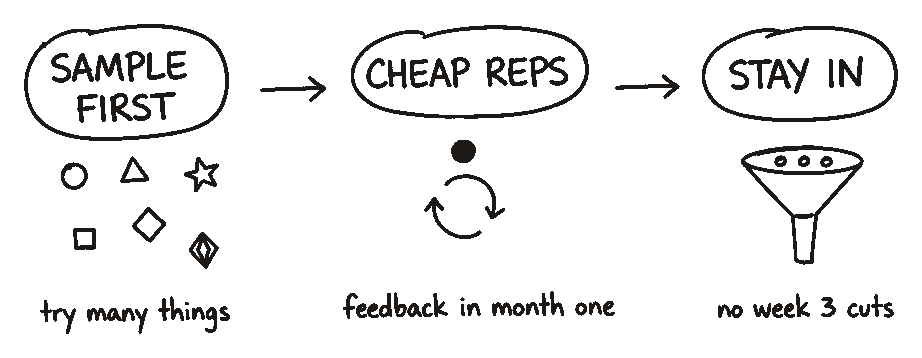
1. Sample first: world class athletes tried more sports and committed later than the merely good (the argument in David Epstein's Range), and German Bundesliga pros reached the top on about 4,264 hours of organised practice, nowhere near the 10,000 hours of structured grind. So try a few tools and 3 small ugly projects before picking your new hobbies.
2. Cheap reps, early feedback: Iceland made it cheap to become a coach and cheap to get one. Most of us do the reverse, and save the good coaching for when we're already good. Just keep doing it until showing up is the default, and get real feedback in month one, while the habits are still fluid. (Find a friend who's already very good at it?)
3. Don't cut yourself at week 3: our rank against our peers mostly reflects starting conditions and says close to nothing about our potential ceiling. The youngest sports academy survivors, i.e. the kids who spent whole childhoods behind, were the ones several times more likely to turn pro. Quitting something you've decided you don't want is fine. Quitting because the week 3 version of you reckons you've got no talent is the relative age effect that you're self-inflicting. Keep going through the ugly periods, just persist!
So if being an elite prospect when you're young/new to something isn't success, what is being world class? Mostly the unglamorous thing I just said above. The world class ones in that research started later, spent longer playing other things, and were still going long after the early picks had been made. Nobody labelled them at 9. They just stayed in long enough to find out what they had.
The next time you're 3 weeks into something and convinced you're not built for it, remember: professional scouts pick 9 year olds for a living, with careers on the line, and 199 of every 200 picks never play a first team game. Nobody can see the ceiling from down there. The players who make it are the ones nobody managed to discard. Cabo Verde found one working in a Dublin bank on LinkedIn.
I reckon we'd be surprised at how capable we are if we tried more things, got help early, and stuck with them.
Stay in the funnel and believe in yourself!
Disclaimer: Thoughts are my own and do not represent any other parties.
Newsletter
I do this for the love of writing.
Each subscriber costs me money, but please do it anyway and spread the word. Monthly at most.
You might also like
The Six Simple Machines of AI
Every AI product in a business is a few of six simple machines bolted together. An assembly inherits every failure of every machine inside it.
Mobile gaming's missing brain
Every studio tracks ARPDAU, ROAS, retention curves. None of them answer the question actually worth asking -- which specific player is about to churn.
AI shopping is years away. The infrastructure isn't.
When the AI does the buying, value migrates from attention to delegation. Stripe's five level map shows where commerce is today and what changes at Level 4.